
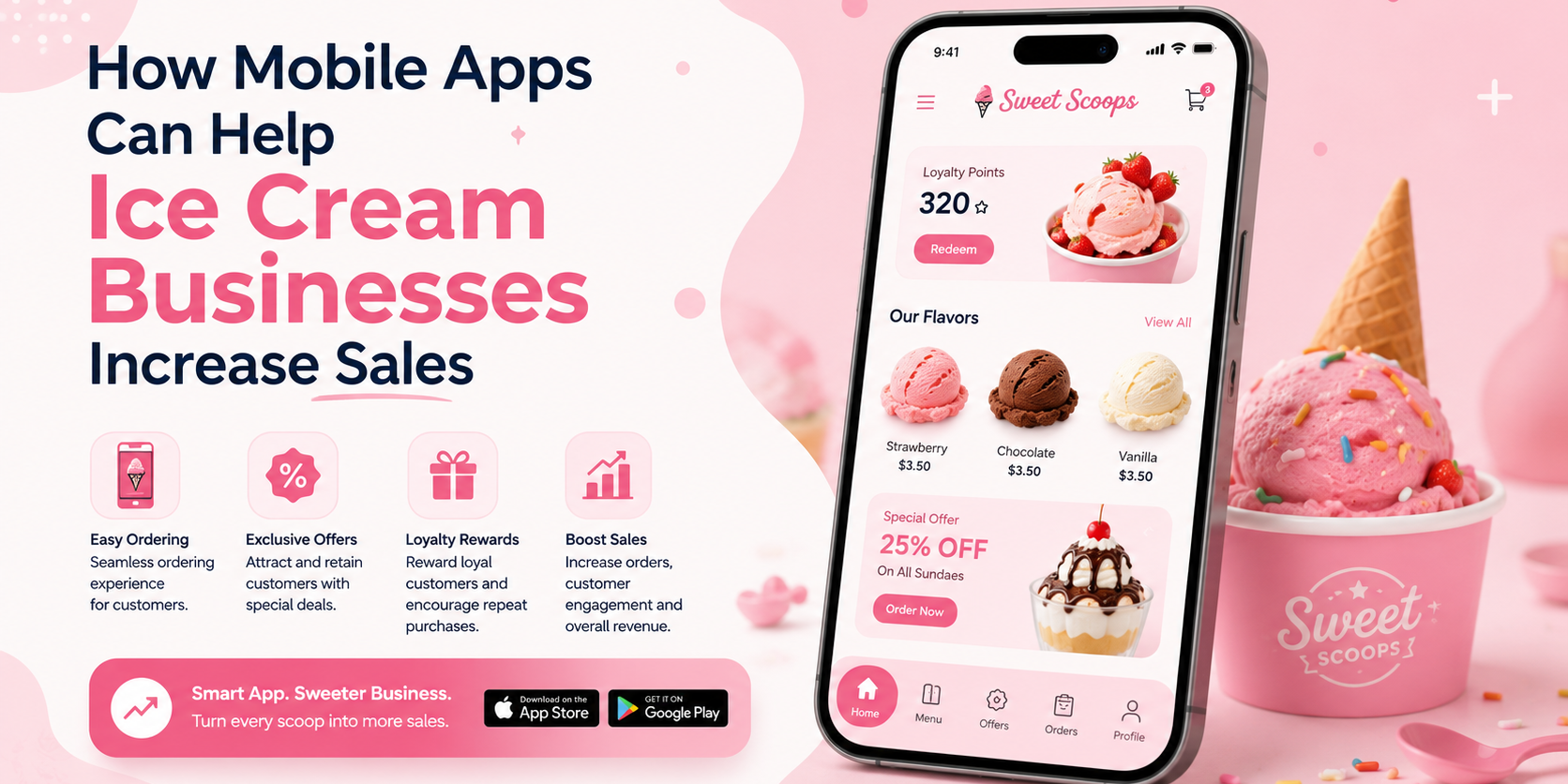
Rosalind Ferreira had been running Sweet Hour, her artisan ice cream parlour in Porto, for four years when she figured out that her biggest competitor wasn’t the gelateria two streets over. It was the couch. On a cool evening in September, when the temperature dropped just enough to make staying home feel more appealing than a ten-minute walk, a significant portion of her potential customers simply didn’t come. They thought about ice cream, they possibly even craved it, and then they settled for whatever was in the freezer because the friction of going out outweighed the pull of the product. Rosalind had spent three years competing on quality, on seasonal flavour creativity, on Instagram photography, and on the warmth of the in-store experience. None of those things reached the customer at the moment they were deciding whether to leave the house. When she finally built a mobile application for Sweet Hour, she expected it to function primarily as a digital loyalty card. What she hadn’t anticipated was that the ability to order ahead for collection, to receive a notification when her weekly new flavour was available, and to see the real-time queue length on a busy Saturday evening would collectively change when and how often her regulars visited. In the first summer after launch, her average weekly transaction volume increased by 23% compared to the equivalent period the prior year. The team she engaged, a Mobile App Development Company that had worked with several independent food businesses, had told her the revenue impact would be strongest in the order-ahead feature. They were right, and the reasons they were right apply to any ice cream business evaluating whether a mobile application is worth the investment. This blog makes that case specifically, with the mechanics behind each feature rather than the generalizations about digital transformation that tend to fill this kind of article.
Order Ahead and the Friction Elimination Argument
The single feature that produced the most direct revenue impact for Rosalind was order-ahead with a scheduled collection time. The mechanism is simple in concept: a customer opens the application, selects their flavours, pays, and chooses a collection window. When they arrive, their order is ready. No queue, no decision paralysis at the counter, no risk of the flavour they wanted being sold out.
Each of those outcomes addresses a real friction point that causes customers to either not visit or to visit less often than they otherwise would. Queue anxiety is genuine: customers who know a popular parlour will be busy on a warm evening will sometimes choose not to go rather than risk a 20-minute wait. Sold-out disappointment is a powerful deterrent to return visits, particularly for customers who made a special trip for a specific flavour. Decision paralysis at the counter, when 24 flavours are staring at you and there is a line forming behind you, reduces enjoyment even when it doesn’t reduce transaction rate.
Order-ahead eliminates all three. The customer has an appointment. Their flavour is guaranteed. The decision was made at home on the sofa where nobody is watching. The visit itself becomes the enjoyable part rather than the stressful part.
For ice cream businesses specifically, order-ahead also produces an operational benefit that compounds over time: advance orders create a demand signal that helps the team prepare the right quantities of each flavour for each shift, reducing both waste from over-preparation and the lost sales from running out of popular flavours before closing time.
Mobile Loyalty Programs That Actually Change Behavior
Paper stamp cards work on the principle that the physical card in a customer’s wallet is a persistent reminder of the relationship with the business. The problem is that wallets are finite and reminder value degrades once a card is buried under three other loyalty cards that the customer is equally unlikely to use. Mobile loyalty programs eliminate both constraints and add capabilities that paper cards structurally cannot provide.
A digital loyalty program that sends a push notification when a customer is four stamps from a reward, that celebrates a customer’s first visit anniversary with a bonus reward, and that provides a personalized offer on a customer’s most frequently ordered flavour is not a digital version of a stamp card. It is a retention tool with behavioural intelligence built into it.
The specific mechanics that drive behavioural change in mobile loyalty programs are well-understood: progress visibility, where seeing stamps accumulating toward a defined reward is intrinsically motivating; streak mechanics, where rewarding consecutive weekly visits creates loss aversion once a streak has been established; and personalized milestone rewards, where the reward feels specific to the customer rather than generic to all participants.
Rosalind’s loyalty program included a “flavour memory” feature that remembered each customer’s order history and occasionally prompted them with “Haven’t had your favourite Salted Caramel in a while” notifications. The click-through rate on those personalized notifications was four times higher than her generic promotional messages, and the visits they generated had higher average transaction values because customers who came in for a specific flavour they had been reminded of often added a secondary choice.
New Flavour Launches and the Notification Moment
Ice cream businesses that introduce seasonal and rotating flavours have a natural marketing asset that most product categories don’t: genuine novelty that recurs regularly and that their most engaged customers actively anticipate. The challenge is that anticipation requires awareness, and awareness requires a communication channel that reaches the customer at a moment when they are receptive to the message.
Social media posts about new flavours reach whoever happens to be scrolling at the moment of posting, which is a fraction of the account’s followers and an even smaller fraction of those followers at a moment when they are making decisions about where to go. Push notifications sent to customers who have opted in specifically to new flavour alerts reach exactly the people who have signalled that this information matters to them, delivered at a time chosen to match their most likely decision window.
Rosalind’s “New This Week” notification, sent every Thursday at 5 PM, reliably produced a spike in Friday and Saturday traffic that she could attribute specifically to the flavours announced. She tracked this by monitoring which flavours were included in orders placed within 48 hours of the notification and found that 62% of the first-weekend demand for a new flavour came from customers who had received the alert.
Seasonal Campaigns and Time-Limited Offers
The psychology of scarcity and urgency is particularly powerful in the ice cream category because the product is inherently seasonal in many markets and customers have learned that certain flavours genuinely disappear. A customer who knows that Rosalind’s Passion Fruit Sorbet is only available for six weeks in summer has a real and rational reason to visit within that window, not just an artificially manufactured urgency.
Mobile applications amplify scarcity signals by providing a countdown mechanism: a banner in the application showing “Passion Fruit Sorbet: 12 days remaining” creates visible time pressure that a social media post cannot. Limited-quantity offers that show remaining units, a “today only” feature where 50 single scoops of a new experimental flavour are available on a first-come basis, and birthday-month offers that feel genuinely personal rather than promotional all leverage the mobile channel’s immediacy in ways that other communication channels can’t replicate.
Pre-ordering for Events and Catering
Ice cream businesses with event and catering capabilities have historically relied on inbound inquiries and manual quotation processes for that revenue stream. A mobile application with a catering inquiry or pre-order module converts a passive product category into an active channel that generates demand rather than waiting for it.
A customer who is planning a birthday party and opens the application at 10 PM when they have time to think about it can browse catering packages, select flavours, specify quantities, choose a delivery window, and submit a booking request without calling anyone. The business receives a structured inquiry with all the information needed to confirm the booking rather than a vague call that begins “I was thinking of maybe getting some ice cream for a party.”
Catering pre-orders placed through the application also tend to be larger in value and higher in conversion rate than phone inquiries, because the friction of assembling the booking is lower and the structured product presentation in the application makes upselling to larger quantities or additional items more natural.
Customer Data as a Strategic Asset
Among the top mobile app ideas that food and beverage businesses consistently undervalue when evaluating mobile investment is the data asset the application creates. An ice cream parlour operating without a mobile application knows its daily revenue, its top-selling flavours by unit volume, and whatever its staff observe about customer demographics. An ice cream parlour with a mobile application knows which customers visit most frequently, which flavours drive repeat visits versus one-time trials, which communication timing produces the most action, which customer segments respond to loyalty mechanics versus novelty promotions, and which weather conditions correlate with which demand patterns.
Rosalind discovered through her application data that her highest-spending customers visited on Sundays and most frequently ordered combinations that included at least one new or seasonal flavour alongside a classic. That insight shaped her Sunday staffing decisions, her flavour rotation timing, and the specific combination suggestions she built into the application’s ordering flow. The application didn’t generate that insight automatically. It created the data infrastructure from which the insight could be extracted.
The Investment Conversation
Building a mobile application for an independent ice cream business doesn’t require the budget of a venture-backed food delivery platform. A well-scoped loyalty, ordering, and notification application built on a platform designed for independent food retailers can be significantly more affordable than the first-year revenue impact of the features it enables. The relevant calculation is not the development cost in isolation but the ratio of that cost to the incremental revenue that order-ahead, loyalty mechanics, and new flavour notifications are likely to generate given the business’s current traffic patterns and average transaction values.
Rosalind’s 23% volume increase in the first summer translated to revenue that covered her application development cost in the first five months. That ratio held because her application was scoped specifically to the features with the clearest revenue impact rather than built as a comprehensive platform with capabilities she didn’t need. The most expensive mobile application is not the one that costs the most to develop. It is the one that is built too broadly to be used well, or too narrowly to deliver the value the business actually needed.
Sweet Hour’s application is on its third major update. Rosalind added a table reservation feature for the outdoor seating she installed the second summer and a corporate gifting module that now accounts for 11% of annual revenue. The couch is still a competitor. It wins less often.